Sada
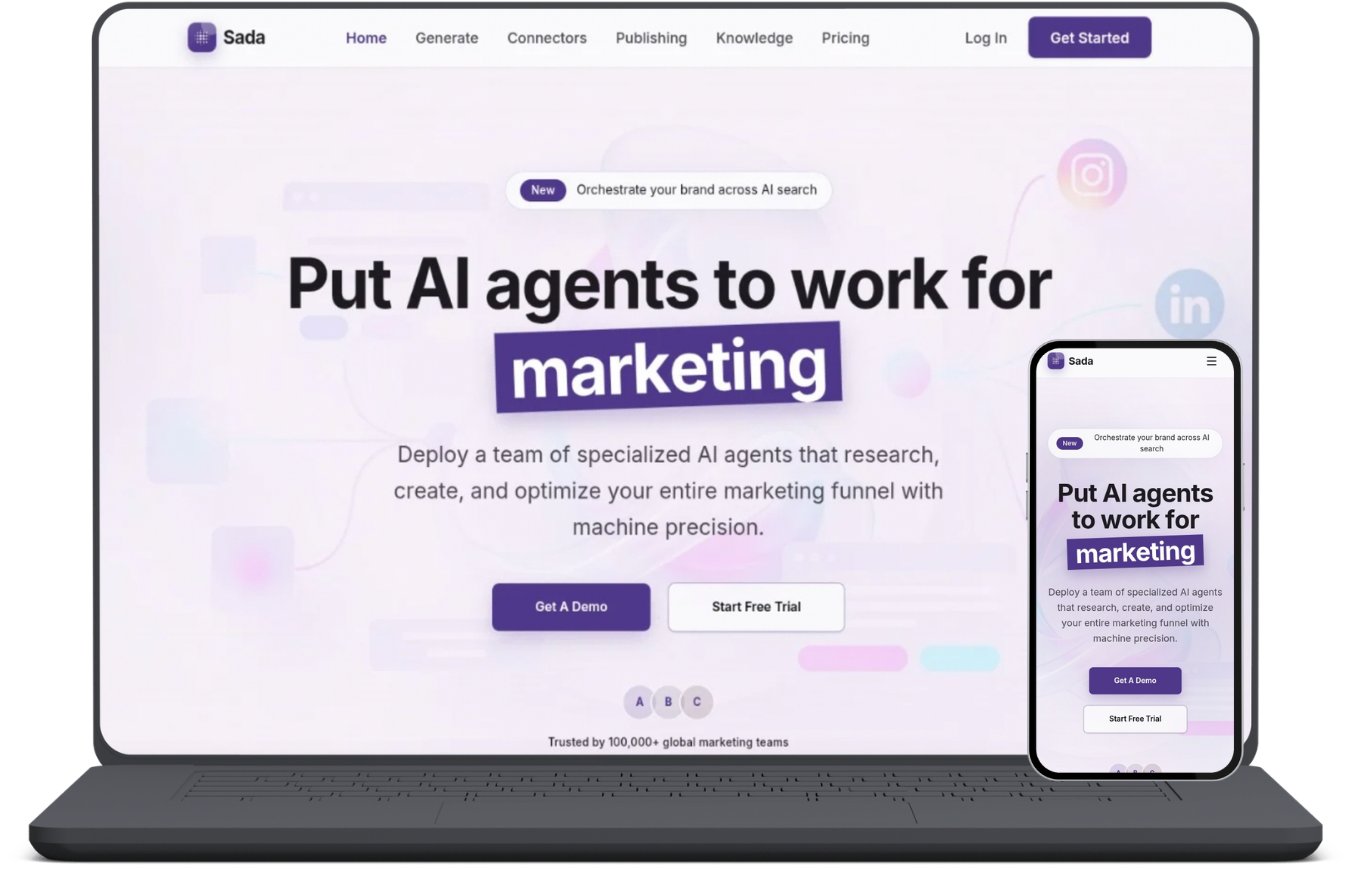
A multi-agent AI platform that turns a raw product brief into a grounded marketing strategy — then into a ready-to-publish, dated content calendar.
Six people, one echo
Built end to end — frontend, backend, and the multi-agent AI engine — by:
Abdelhamid Robaa
Yasser Tawfik
AbdelRahman ElSayed
Abdullah ElSawalmy
Mohamed Shalaby
Mohamed Hamdy
Creators do the work of an entire marketing team, alone.
Planning a launch means segmentation, positioning, personas, a content calendar, platform-specific copy, hashtags, visuals, and QA — usually done with five disconnected tools and no memory between them.
No single source of truth
Strategy lives in a doc, content lives in a scheduler, brand facts live in someone's head. Nothing stays consistent.
Chatbots don't plan
A single prompt to ChatGPT gives you a caption, not a strategy grounded in who the audience is and why it matters.
Nothing checks the output
Generic tools have no QA pass, no claim verification, and no approval step before content ships.
One system, two coordinated agent workflows, a human in the loop.
Sada is a full-stack platform where specialized AI agents each own one job — research, positioning, copywriting, QA — and hand off structured, validated data to the next agent. Nothing is a raw paragraph of text passed hopefully downstream.
Marketing Director workflow
6 strategy specialists turn a product brief into segmentation, personas, journeys, objectives, and a campaign plan.
Content Creation workflow
6 content specialists turn an approved strategy into on-brand posts, visuals, hashtags, and a dated calendar.
Approval, not autopilot
The creator reviews the strategy before content is generated, and can approve or send content back with feedback.
What it's built with
Frontend
 React 19
 Vite 8
 Tailwind CSS 4
 React Router 7
 shadcn 4
 Framer Motion 12
 React Hook Form 7
 Zod 4
Zod 4 Stripe.js 9
Backend
 NestJS 11
 Prisma 6
 Crawlee 3
 PostgreSQL
 Better Auth 1.6
 BullMQ 5
 Stripe 22
 Jest 30
AI Engine
 Mastra Core 1.54
 Zod 4
Zod 4 Mastra PG 1.18Mastra Evals 1.6Mastra Obs. 1.16
 Tavily 0.7
 Perplexity 0.2
 Vitest 4
Three repos, one pipeline
The browser talks only to the NestJS system of record. Nest persists each run, queues asynchronous work, and lets backend workers call Mastra through one canonical server-to-server client.
PostgreSQL
Backend records remain authoritative; pgvector supports scoped project knowledge.
BullMQ + Redis
Requests return quickly while workers execute generation asynchronously.
Model + search providers
LLM, web research, embeddings, and image providers stay behind Mastra.
The Marketing Director pipeline
A raw product description becomes a complete, structured strategy: segmentation, targeting, positioning, personas, journeys, SMART objectives, and a campaign plan.
Understand
Input + contextStrategize
Audience + positionActivate
Plan + validateStrategy in, calendar out
The approved campaign strategy is turned into a content brief, then researched, drafted, checked, approved by a human, illustrated, tagged, and scheduled.
Ground
Strategy + contextCreate & Review
Draft + approveEnrich & Publish
Parallel + schedule13 specialist roles, one accountable system
| Specialist | Job | Workflow |
|---|---|---|
| Product Analysis | Extracts a structured product profile from the raw brief | Strategy |
| STP Strategy | Segmentation, targeting, positioning | Strategy |
| Buyer Persona | 1–3 grounded buyer personas | Strategy |
| Buyer Journey | Funnel stages and touchpoints per persona | Strategy |
| SMART Objectives | Measurable campaign goals | Strategy |
| Campaign Planner | Channels, budget allocation, content mix | Strategy |
| Content Researcher | Trends, hashtags, audience context | Content |
| Content Strategist | Content strategy from brief + research | Content |
| Copywriter | On-brand posts per platform | Content |
| Editor / QA | Reviews drafts, triggers a bounded rewrite | Content |
| Visual Prompt | Image/video prompts + generation per post | Content |
| Hashtag / SEO | Ranked hashtags and keywords | Content |
| Chat Title | Names each session for the workspace UI | Shared |
What the agents can actually call
Agents don't just generate text — they call typed, bounded tools for anything that needs to be real: live data, brand rules, or a verifiable calculation. Every tool has a Zod input/output contract, same as an agent handoff.
Grounding
Web Search
Uses Tavily for current market, competitor, and industry signals.
Research Evidence
Caches citable excerpts with publisher, URL, and relevance score.
Perplexity Search
Returns AI-summarized web research for faster content discovery.
Brand safety
Brand Context
Retrieves approved voice, claims, prohibited terms, and tone examples.
Claim Verifier
Marks each claim approved, evidence-linked, or unsupported.
Platform Rules
Returns platform limits, hashtag conventions, CTA style, and formatting rules.
Production
Content Calendar
Turns approved posts into a dated, cross-platform publishing schedule.
Image Generation
Builds an enhanced visual prompt and image spec for each post.
UTM Builder
Creates normalized, campaign-tracked URLs without a model call.
Why specialist roles, not one giant prompt?
- Single responsibility prompts. Every agent has an explicit "you never do X" clause — the copywriter never invents strategy, the QA agent never writes copy.
- Zod-validated handoffs. Every agent returns a schema-checked object, not free text. Nothing downstream has to guess a shape.
- No hallucinated facts. Agents list unknowns in an
assumptionsfield instead of inventing numbers.
- Independently testable. Each step factory takes its agent as a dependency, so tests swap in a mock and assert behavior deterministically.
- Focused extension. New roles such as Market Research, Competitor Analysis, SEO, or Analytics can enter at explicit workflow boundaries.
- Model-agnostic. Any agent can be pointed at a different model string without touching its prompt or schema.
The hard problems weren't prompting
Deterministic checks beside the LLM
A rule-based preflight and a claim-audit step catch platform, policy, and unverified-claim issues that don't need — and shouldn't rely on — a model call.
Bounded QA loop
QA runs one review-and-rewrite cycle by design, keeping worst-case model time under the backend's fixed run deadline instead of looping until "perfect."
RAG over brand knowledge
Approved brand facts are retrieved via pgvector before content is drafted, using swappable Gemini or local Ollama embeddings.
Parallel independent steps
Visual prompt generation and hashtag/SEO generation run concurrently once copy is approved — they don't depend on each other.
Suspend / resume for human review
The content workflow can pause after QA and wait — potentially indefinitely — for a reviewer's approve/reject decision before continuing.
Multi-provider model routing
One config string switches every agent between OpenCode Go, OpenAI, Anthropic, or Google models — no prompt rewrites.
What the creator actually sees
Generate
Fill a campaign brief, watch the strategy stream in, review and approve it, then watch content, visuals, and hashtags assemble into a calendar.
Knowledge
A brand knowledge base with an "ask" panel — the same source Sada retrieves from when it grounds content in real brand facts.
Connectors
A dashboard for connecting supported social accounts and managing approved publishing flows.
Billing
Stripe-backed plans and subscription management, built directly into the app rather than bolted on.
Auth
Session-cookie authentication with email/password, OTP login, and email verification — no tokens sitting in browser storage.
History
Every brief, reviewed strategy, and completed campaign is saved to the project sidebar so nothing is lost on refresh.
Tested like production software
The AI engine treats agents as ordinary dependencies — every workflow is unit- and integration-tested without ever calling a real model.
- Per-agent unit tests. Each agent is built for real, then
agent.generateis patched with a typed mock returning a fixture — the wiring is exercised, only the LLM call is faked. - Integration tests. Full workflows are composed with mocked agents and asserted end-to-end against the schema contract.
- Schema tests. Every Zod contract has its own tests, independent of any agent.
- Repeatable quality checks. Typecheck, tests, and production builds provide the release gate for workflow changes.
What Sada does that a chatbot can't
vs. a single ChatGPT prompt
One prompt gives you one guess. Sada coordinates 13 specialist roles through schema-validated handoffs, so approved strategy informs content instead of being discarded between steps.
vs. Buffer / Canva / schedulers
Those tools start after the strategy exists. Sada generates the strategy itself, then the content that follows from it, in one traceable pipeline.
Guardrails, not just generation
Deterministic preflight checks and a claim audit run alongside the model — output is checked, not just produced.
A creator stays in control
Strategy approval and content approval are explicit steps, not an afterthought — the workflow literally pauses and waits.
Where Sada sits in the 2026 market
Most tools either schedule content you already planned, or optimize a brand presence you already have. Sada starts one step earlier — from a raw product brief, with nothing yet decided.
| Dimension | Scheduling tools Buffer, Hootsuite |
Autonomous agents Trellis, NoimosAI |
Sada |
|---|---|---|---|
| Starting point | You already have a strategy | You already have a brand presence | A raw product brief — nothing exists yet |
| Strategy work | None — you bring your own | Optimizes an existing strategy over time | Generates the strategy itself: STP, personas, journeys, objectives |
| Output check | None | Performance-based, after the fact | Deterministic guardrails before publish — preflight + claim audit |
| Human role | Approves everything manually | Approves broad strategy, agent runs loosely after | Explicit approval gate built into the workflow itself |
Honest about what's next
Current limitations
- Cost and latency scale with the number of agent calls per run.
- Publishing coverage depends on configured provider credentials and currently supported channels.
- Quality depends on the underlying model — provider outages or drift affect output.
Next capabilities
- Competitor intelligence with deeper, cited source coverage.
- Campaign analytics that feed measured results back into planning.
- SEO performance beyond keyword generation and content metadata.
- Publishing coverage across more channels and account types.
Strategy that survives the handoff
From raw brief to approved campaign, with every decision traceable.
Questions? Explore the three independently versioned parts of Sada.